- WellDev
- WellDev Interview Experience
- Trainee Software Engineer
- Software Engineer Interview
- MCQ Questions
- Technical Interview Questions
- Interview Preparation
- Data Structures and Algorithms
- DBMS
- SQL
- Docker
- OOP
WellDev Trainee Software Engineer Interview Experience: 60 MCQs & Technical Rounds
Explore my WellDev Trainee Software Engineer interview experience, including the 60-question MCQ exam, questions collected across multiple batches, two technical interviews, coding problems, DSA, SQL, Docker, authentication, and analytical puzzles.
 Mehedi Hasan14 min read
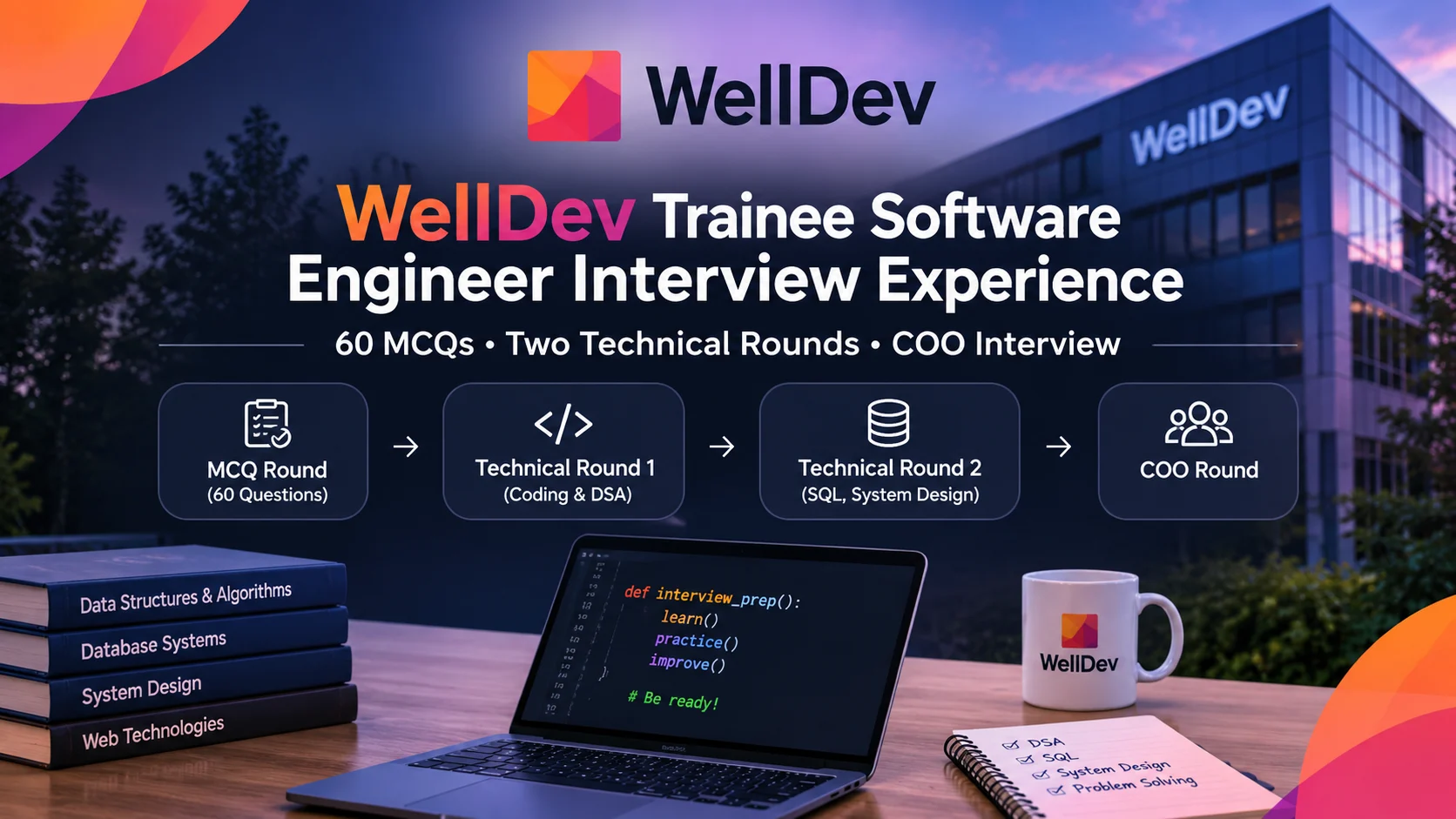
WellDev Trainee Software Engineer Interview Experience: 60 MCQs, Two Technical Rounds & COO Interview

Preparing for a software engineering interview involves much more than practicing coding problems. You also need a solid understanding of computer science fundamentals, problem-solving skills, and the ability to explain your technical decisions.
I recently participated in the recruitment process at WellDev for the position of Trainee Software Engineer. The process covered a wide range of topics, from basic programming and data structures to databases, system design, Docker, authentication, and analytical reasoning.
Unfortunately, I wasn't able to make it to the final stage. However, the experience was valuable, and I decided to share the questions I encountered to help other candidates prepare.
WellDev Interview Process
The recruitment process consisted of the following stages:
- MCQ Round: A multiple-choice examination containing 60 questions.
- First Technical Round: Programming fundamentals, coding, OOP, and SQL.
- Second Technical Round: DSA, algorithm analysis, backend concepts, project discussions, and problem-solving.
- Final COO Round: The next stage after the technical interviews.
A note about the MCQ questions
The MCQ examination was conducted in multiple batches. Each candidate participated in an exam containing 60 questions.
After the examinations, candidates from different batches contributed the questions they remembered. We collected those questions into a consolidated question bank so that others could get a broader idea of what was covered.
Important: The MCQ questions listed below are collected from multiple batches. They are not a claim that all of these questions appeared together in one 60-question paper. Some questions and code snippets are reconstructed from memory, so their exact wording may differ from the original exam.
Round 1: MCQ Examination - 60 Questions
The first round tested a broad range of computer science topics. It included DSA, programming languages, DBMS, operating systems, networking, APIs, system design, CSS, and analytical reasoning.
Here are the questions collected from different batches.
1. Data Structures and Algorithms
Some of the questions included:
Which algorithm is suitable for sorting a linked list?
Remembered answer: Merge Sort.
Which data structure implements Last In, First Out (LIFO)?
Answer: Stack.
Which data structure supports insertion and deletion from both ends?
Answer: Deque.
Which sorting algorithm is generally considered the slowest among the given options?
Remembered answer: Bubble Sort.
What is the average time complexity of Quick Sort?
Answer: O(n log n).
What is another name for a Trie?
Remembered answer: Digital Tree; also known as a Prefix Tree.
Given a Binary Search Tree, what is the result of its inorder traversal?
Answer: Elements in sorted order.
Identify the false statement about a Min Heap.
Which data structure is efficient for storing and searching strings?
Answer: Trie.
Given a graph, determine its BFS traversal order. When multiple adjacent nodes are available, visit the alphabetically smaller node first.
Which algorithm can be used to find a Minimum Spanning Tree?
Remembered answer: Prim's Algorithm.
Given an array of elements inserted into a BST in a particular order, determine the fourth element in its inorder traversal.
2. Output Tracing and Time Complexity
Several questions required candidates to predict program outputs or calculate time complexity.
Python string slicing:
s = "Trainee123"
print(s[2:8:2])
Determine the output.
Loop analysis:
int a = 0, i = N;

while (i < N) {
    for (int j = 0; j < N; j *= 2) {
        // Some operation
    }
}
Determine the time complexity.
Python mutable default argument:
def append_to_list(value, my_list=[]):
    my_list.append(value)
    return my_list

list1 = append_to_list(1)
list2 = append_to_list(2, [])
list3 = append_to_list(3)

print(list1)
print(list2)
print(list3)
What will be printed?
Other output-tracing topics included:
- Pointer operations and changes in variable values.
- Array traversal and printing.
- Repeated multiplication of a variable.
- Recursive Fibonacci-like functions.
- Recursive function calls such as
someMethod(0). - Nested loops and their time complexity.
- Stack push and pop operations.
- Recursive functions using memoization.
- JavaScript
typeof()behavior. - String manipulation and number reversal.
Some of the original snippets in our collected notes were incomplete, so I have kept them as topic descriptions rather than presenting reconstructed code as the exact exam questions.
3. Database Management Systems
The DBMS section included scenario-based questions:
- Identify a scenario demonstrating the Durability property of ACID.
- Identify a scenario involving an Update Anomaly.
- Identify a Lost Update or Phantom Read problem from a database concurrency-control scenario.
4. API and HTTP
Some API-related questions included:
A user tries to access a system without logging in. Which HTTP status code should be returned?
Remembered answer: 401 — Unauthorized.
A logged-in user tries to access a resource for which they do not have permission. Which status code should be returned?
Remembered answer: 403 — Forbidden.
5. Operating Systems
Which concept is used to protect a critical section and help prevent race conditions?
Remembered answer: Critical Section.
6. System Design and Design Patterns
Two questions from this section were:
If an event needs to trigger actions in multiple services or components, which design pattern could be used?
Remembered answer: Observer Pattern.
Which design pattern centralizes communication between objects?
Remembered answer: Mediator Pattern.
7. Programming Languages
Some of the questions included:
Which is not a relational or logical operator in C++?
Which type of memory is commonly used for function calls and local variables?
Remembered answer: Stack memory.
Which data structure can be used to implement a linked list?
Which implementation is the most memory-efficient for a given data structure?
8. Analytical and Logical Reasoning
There were several questions that tested logical thinking and mathematical reasoning.
Some examples:
Age arrangement
Karim is younger than Rahim. Rahim is older than Shahid, and Alim is younger than Rahim. Arrange them from oldest to youngest and identify the second person.
Painted cube
A rectangular block measuring 5 × 4 × 3 units is painted blue on all its outer surfaces and then cut into 1 × 1 × 1 cubes.
How many smaller cubes have exactly one blue-painted surface?
Another version involved a 3 × 3 × 4 block and asked how many smaller cubes had exactly two painted surfaces.
Number series
Find the next number:
1, 3, 7, 15, 31, 63, ?Other analytical topics included:
- Number-series completion.
- Knight-and-knave logic puzzles.
- Seating-arrangement problems.
- Family-relationship questions.
- Clock and train-related mathematical problems.
- Identifying Fibonacci numbers.
- Comparing scores and arranging people by their scores.
- Direction and distance problems.
- Arrangement puzzles involving people, floors, and areas of expertise.
One of the larger arrangement questions involved five people living on five different floors, with each person having a different technical specialization: AI, Cybersecurity, DevOps, Data Science, and Cloud Computing. Candidates had to use the provided clues to determine who had which specialization.
The three-switch puzzle
There were three switches outside a closed room and one bulb inside. Only one switch controlled the bulb, and candidates could enter the room only once.
How could they identify the correct switch?
The remembered solution was to turn Switch A on for a few minutes, turn it off, then turn Switch B on before entering the room. The bulb's state and temperature would reveal the correct switch, assuming the bulb produces noticeable heat.
9. CSS
Some CSS questions included:
- Which CSS styling method has the highest priority among inline, internal, external, and global styles?
- Identify the correct CSS syntax:
body {
    color: black;
}
10. Security and Networking
Questions from this section included:
- Which OSI layer is responsible for routing?
- A logged-in banking user visits a malicious website. That website secretly sends a request to the banking site using the user's active session, resulting in an unauthorized transaction. What type of attack is this?
- For the IP address
192.168.10.100/26, how many usable hosts are available in the subnet?
11. More Recalled MCQ Questions
A few additional questions collected from candidates across batches included:
- Which data structure is commonly used to implement recursion?
- What is the difference between HTTP 4xx and 5xx errors?
- A website contains a fake form created by an attacker. Identify the possible security attack.
- What is the complexity of two nested loops where the inner loop runs from 0 to the current outer-loop index?
- What is the time complexity of a recursive Fibonacci function?
- Which data structure is suitable when insertions frequently happen in the middle of a list but traversal is rare?
- What is the difference between passing an argument by value and modifying the original variable?
- What is the best data structure for implementing a stack?
- What is the output of a nested loop that increments a counter?
- Which file-opening mode allows writing even if a file does not exist?
- What causes a memory leak?
- What is the purpose of memoization?
- What is the purpose of Base64URL encoding in JWT?
- What is the difference between assignment and relational operators?
- What happens when elements are inserted into a BST and its root is removed?
There were also questions involving clock calculations, character sequences, word transformations, stack operations, and logical arrangements.
Overall, the MCQ round was quite broad. Preparing only DSA or programming-language fundamentals would not be enough; candidates should revise core CS subjects as well.
Round 2: First Technical Interview
After the MCQ examination, the next stage was the first technical interview.
This round focused on coding, programming fundamentals, OOP, and SQL. Here are the questions I remember.
1. Reverse a String
Problem: Write a function that takes a string and returns the reversed string.
Input:  "hello"
Output: "olleh"
One possible C++ solution:
string reverseStr(string s) {
    string ans;

    for (int i = (int)s.size() - 1; i >= 0; i--) {
        ans += s[i];
    }

    return ans;
}
Another approach is to swap characters from both ends:
void reverseString(string &s) {
    int i = 0;
    int j = (int)s.size() - 1;

    while (i < j) {
        swap(s[i], s[j]);
        i++;
        j--;
    }
}
Complexity: Both approaches take O(n) time. The first uses O(n) additional space, while the second uses O(1) auxiliary space.
2. Two Sum Using Sorting and Two Pointers
Problem: Given an array and a target value, find pairs of elements whose sum equals the target and return their original indices.
Example:
Input:
nums = [2, 7, 7, 11, 15, 3, 6]
target = 9

Remembered output:
[0, 1]
[5, 6]
I approached the problem using sorting and two pointers. I stored each number with its original index so that sorting would not lose the original positions.
The main concepts involved were sorting, two pointers, and preserving original indices.
Complexity: Sorting takes O(n log n), and the two-pointer traversal takes O(n).
Note: The remembered sample contains duplicate values and multiple valid index combinations. The exact original problem constraints and expected handling of duplicates may have differed.
3. Java Constructor Execution Order
The interviewer provided a simple Java inheritance example and asked about its output.
class Shape {
    public Shape() {
        System.out.println("shape constructor");
    }
}

class Circle extends Shape {
    public Circle() {
        System.out.println("circle constructor");
    }
}

class Square extends Circle {
    public Square() {
        System.out.println("square constructor");
    }
}

public class Test {
    public static void main(String[] args) {
        new Square();
    }
}
Output:
shape constructor
circle constructor
square constructor
The parent-class constructor executes before the child-class constructor.
4. SQL: Increase Employee Salary
Suppose an employee table contains salary and experience columns. Increase the salary by 10% for employees whose experience is greater than five years.
UPDATE employee
SET salary = salary * 1.1
WHERE experience > 5;
5. SQL: Find the Second-Highest Salary
Write a query to find the second-highest distinct salary.
SELECT DISTINCT salary
FROM employee
ORDER BY salary DESC
LIMIT 1 OFFSET 1;
Another approach is to use a subquery with MAX().
SELECT MAX(salary)
FROM employee
WHERE salary < (
    SELECT MAX(salary)
    FROM employee
);
Round 3: Second Technical Interview
The second technical round was more focused on algorithm analysis, backend development, and practical problem-solving.
1. Sorting Algorithms and Their Complexities
I was asked about the time complexities and details of different sorting algorithms.
Here is a quick comparison:
| Algorithm | Best Case | Average Case | Worst Case |
|---|---|---|---|
| Bubble Sort* | O(n) | O(n²) | O(n²) |
| Selection Sort | O(n²) | O(n²) | O(n²) |
| Insertion Sort | O(n) | O(n²) | O(n²) |
| Merge Sort | O(n log n) | O(n log n) | O(n log n) |
| Quick Sort | O(n log n) | O(n log n) | O(n²) |
| Heap Sort | O(n log n) | O(n log n) | O(n log n) |
Bubble Sort achieves O(n) best-case time when implemented with an early-exit optimization.
Candidates should understand how these algorithms work, their space complexities, and when they are useful.
2. Find an Equilibrium Index in an Array
Problem: Given an array, find the position where the sum of elements on the left equals the sum of elements on the right.
Example:
Input: [1, 7, 3, 6, 5, 6]

Output: 3
At index 3, the value is 6.
Left sum  = 1 + 7 + 3 = 11
Right sum = 5 + 6 = 11
One efficient solution uses the total sum and a running left sum.
int equilibriumIndex(vector<int>& nums) {
    long long total = 0;

    for (int x : nums) {
        total += x;
    }

    long long leftSum = 0;

    for (int i = 0; i < (int)nums.size(); i++) {
        long long rightSum = total - leftSum - nums[i];

        if (leftSum == rightSum) {
            return i;
        }

        leftSum += nums[i];
    }

    return -1;
}
Complexity:
- Time: O(n)
- Auxiliary space: O(1)
3. Docker
I was asked about Docker and its practical usage.
Some important topics to prepare:
- What is Docker?
- Containers vs. virtual machines.
- Docker images and containers.
- Dockerfile and Docker Compose.
- Port mapping.
- Container-to-container communication.
- Connecting an application to a database running in another container.
4. Authentication: JWT vs. Sessions
Authentication was another important discussion.
The questions covered:
- JWT-based authentication vs. session-based authentication.
- Access tokens and refresh tokens.
- How authentication tokens are generated and validated.
- Where session information is stored.
- How refresh tokens are used to obtain new access tokens.
5. Questions About My Projects
The interviewers asked about my projects and what I had actually implemented.
The discussion went beyond simply describing project features. I needed to explain my implementation choices and technical decisions.
My suggestion is to prepare every project mentioned in your CV thoroughly. Be ready to explain the architecture, database design, authentication flow, APIs, and the features you personally developed.
6. The 100 Prisoners and Light Switch Riddle
This was one of the most interesting problems in the interview.
Problem:
100 prisoners are kept in solitary confinement. Every day, the warden randomly selects one prisoner and takes them into an interrogation room. Inside the room, there is a light switch that can be turned ON or OFF.
The prisoners cannot communicate after their initial meeting. However, they can agree on a strategy beforehand.
One prisoner can declare that all 100 prisoners have visited the room. If the declaration is correct, everyone is released. If it is incorrect, the opportunity is lost.
The initial state of the light is OFF.
Question: What strategy guarantees that a prisoner can eventually make the correct declaration?
Solution: The Counter Strategy
Before the process starts, the prisoners select one person as the counter.
- The other 99 prisoners can each turn the light ON only once during the entire process.
- A non-counter prisoner turns the light ON only if it is currently OFF and they have not previously sent their signal.
- If the light is already ON, they do nothing.
- Whenever the counter enters the room and finds the light ON, they turn it OFF and increase their count.
- When the counter has counted 99 signals, they know all 99 other prisoners have visited the room. Since the counter has also visited, all 100 prisoners have been there.
The counter can then safely make the declaration.
This strategy assumes the light starts OFF and the random selection process continues indefinitely.
7. Find a Common Appointment Time Slot
Another problem involved two candidates, each having a list of appointments. I was asked to find a common time range during which both candidates could schedule an appointment.
This can be approached as an interval-overlap problem.
If the inputs are sorted lists of available time intervals, two pointers can efficiently identify their common slots.
Complexity: O(n + m) time for two sorted lists containing n and m intervals.
The exact original problem statement and whether the inputs represented booked appointments or available periods may have been slightly different from my recollection.
Round 4: Final COO Interview
After the two technical rounds, the process included a Final COO round.
I don't have a sufficiently reliable list of questions from this stage to publish, so I won't invent questions or attribute general HR questions to the COO interview.
My Experience and Takeaways
Unfortunately, I wasn't able to make it to the final stage of the recruitment process.
The experience made me realize that solving coding problems alone is not enough. A software engineer needs a strong understanding of DSA, databases, operating systems, networking, authentication, and practical software development.
Here are some suggestions for candidates preparing for a similar interview:
- Strengthen your fundamentals: Revise OOP, DBMS, operating systems, networking, and basic programming concepts.
- Practice DSA regularly: Focus on arrays, strings, stacks, queues, trees, graphs, recursion, sorting, and binary search.
- Understand complexity analysis: Be prepared to explain the time and space complexity of your solutions.
- Prepare your projects: Understand every feature and technical decision mentioned in your CV.
- Practice logical reasoning: Puzzles and analytical questions can appear unexpectedly.
- Understand backend fundamentals: Docker, authentication, REST APIs, SQL, and concurrency are worth preparing.
- Explain your approach: Interviewers are often interested in your reasoning, not just the final answer.
Final Thoughts
Although I couldn't make it to the final stage, I consider this interview a valuable learning experience. It helped me identify areas where I needed to improve and reminded me that strong software engineering fundamentals are essential for building a successful career.
I hope this experience and the consolidated question collection help other candidates prepare for the WellDev Trainee Software Engineer recruitment process.
Best of luck to everyone preparing for their next interview!